Showing posts with label advice. Show all posts

Monday, November 27, 2006

Incandescent? Florescent? Metal Halide? The Pros and Cons of Various Lighting Fixtures to Keep Your Indoor Orchids Flourishing

Image Courtesy of Hydro Gardens

There are several options when it comes to artificial light for orchids. Orchids need certain kinds of light in order to grow well and bloom. They also need enough of this light. Normal incandescent bulbs may look bright, but they are the least efficient source of lighting for plants. This is because they consume a lot of power and put out a lot of heat energy, but produce very little light that is useful for plants. Florescent light is far better in terms of the amount of usable light energy produced versus the amount of power used and the amount of heat produced. For most hobbyist and household orchid growers florescent light will be the most logical choice. One of the options for lighting is Metal Halide and High Pressure Sodium fixtures. These can be good choices for someone who has a lot of orchids, or a number of large orchids. MH and HPS fixtures put out a lot of light, but also produce a lot of heat. They can be very expensive and need to be housed in a specially designed casing with a ballast. They also tend to suck a lot of power and can be expensive to run.

Best Artificial Orchid Lighting Set-ups, Pros and Cons

Incandescent Bulbs: Normal incandescent bulbs you buy to light your house are essentially useless to orchids. You will need specialty broad spectrum bulbs. These bulbs have a spectrum of light that plants can use for photosynthesis. However, these lights are inefficient and will only be enough for one or two plants and will need to be so close that they may burn the plant, in order to do any good.

Florescent Fixtures: These are the most practical choice for most home growers. They are efficient, but still need to be used in an effective way. There are essentially two options. Compact florescent bulbs can be used by themselves in order to light a few plants. Otherwise, tubes can be used, but for most orchids two to four tubes will be necessary. Orchids that need greater light should be grown closer to (almost touching the tubes), those that need less can be grown farther away. Generally you will need to buy broad spectrum, or full spectrum bulbs, in order for them to be effective. These also will not work for tall orchids (because the light will not reach the lower parts of the plant), or very high light orchids, such as most Vandas. Florescent light can be highly economical and does not produce a lot of heat.

High Pressure Sodium Fixtures: These are the most effective lights for growing over a large area. They put out a lot of light, but also use a lot of energy. I have a 250 Watt HPS system and this allows me to grow orchids over approximately a five foot area. The fixture should generally be hung two to four feet above the plants. There are three drawbacks to these systems: They produce a lot of heat, they are expensive to run and the light they put out is in the red spectrum, so it does not look quite natural. This red light tends to encourage flowering, but can cause strange plant growth. They are also complicated to install and can be unsafe. The two most reputable companies that produce these fixtures are Sun System and Hydro Farm. If not properly installed these can be a fire hazard, so make sure yours is UL listed. They also tend to be at least $200 for a new system.

Metal Halide: These fixtures are a lot like the HPS ones, but the light appears more natural because it is further in the blue spectrum. This light also encourages healthier plant growth.
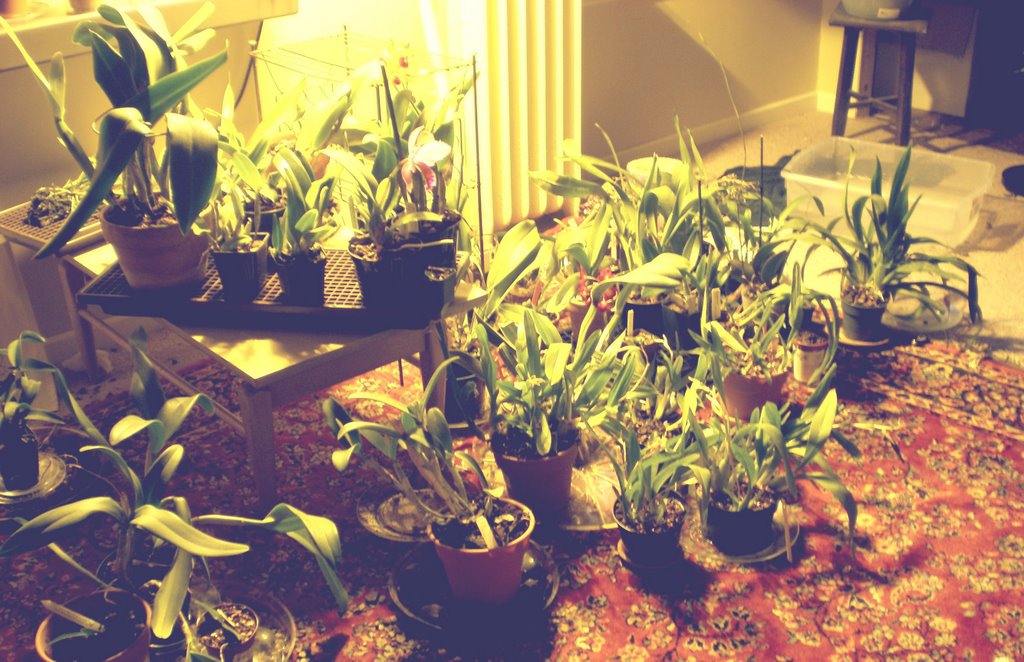
Here is a picture of my High Pressure Sodium Setup
Sunday, November 26, 2006

Getting the Right Temperature Change for Orchids to Bloom

Image courtesy of DHD Multimedia Gallery

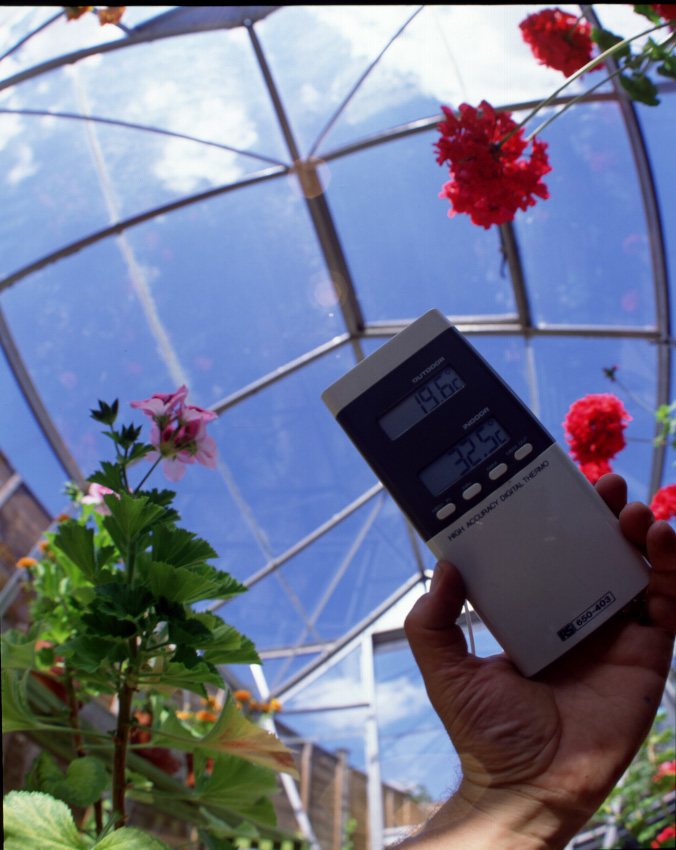
If you want your orchids to flower, you must find a way to raise the temperature by ten to twenty degrees between nighttime and daytime. Orchids can grow fine with less temperature change, but in order to initiate flower buds, they need a large temperature variation. This is one of the main reasons orchids don’t bloom in the home. In a greenhouse and outside this change is no problem, but to reproduce it in the home certain measures must be taken to ensure that your orchids get the temperatures they need. Here are five steps you can do to get a proper day and night variation in temperature.

  1. Place the orchids somewhere in the house that naturally gets a major temperature variation, such as an enclosed porch or sunroom.
  2. Move the orchids close to a window, or into the basement overnight to achieve a greater temperature variation.
  3. Set the thermostat to get a couple degrees warmer than you’re comfortable with during the day, such as 75 degrees and a couple degrees cooler than you’re comfortable with at night, such as 65 degrees. This will establish the absolute minimum temperature variation orchids need.
  4. Place the orchids outside for the summer, in a shaded area. Outside your orchids will have no trouble getting the temperature variation they need.
  5. In general a room is warmer near the ceiling than near the floor. You can place orchids further up in the room, such as on high shelves during the day and then move them close to the floor at night. This can also be the case for upstairs and downstairs. If you grow under lights, place the orchids that need warmer temperatures near the lights and the cooler one’s further away and then move them at night.

Tomorrow I will cover the basics of artificial light. Light gardening is a new and viable option for those of us in the dark north, or in a small space with few windows.

Also check back for the ideal temperature ranges for different orchids.

Friday, November 24, 2006

Some Good Advice on Buying Orchids

Picture is of Parkside Orchid Nursery courtesy of Arianna miles B&B

The tradeoff is simple, when you buy orchids from a reputable grower you get good quality plants. Generally speaking you do pay more to buy from a quality grower, but you save a lot of time you would otherwise spend on repotting and trying to treat sick plants. Generally speaking mail-order nurseries devoted to orchids are a better bet than local nurseries that receive large shipments of orchids, but those smaller independent nurseries are still a much better choice than big box stores. Here is some basic advice on finding good orchid sellers.

  1. Check out mail order nurseries and greenhouses devoted exclusively to orchids. These places can sometimes be pricey, but you will usually get good plants. Generally you pay more for better plants.
  2. See if you can find anyone online who has written about the greenhouse or store in question. What did they have to say?
  3. Ebay can sometimes (but not always) be a good way to get plants. I have purchased some really nice plants on ebay and I have also purchased some horrible plants. The deals are good, but buying on ebay is a big risk.
  4. Go to the nursery or greenhouse yourself so that you can check out the plants. Small local nurseries and plant stores can be places to get very nice plants.
  5. There are a lot of mail order orchid nurseries out there. I recommend checking out the Orchid Mall, they have compiled a long list of orchid sources. A couple great mail order companies that I recommend in the Midwest are Oak Hill Gardens and Orchids Limited. I have also heard good things about J & K Orchids. However, there are hundreds of mail order orchid places all over the world and the Orchid Mall has them listed by country as well as alphabetically.

Thursday, November 23, 2006

What Everybody Ought to Know about Buying Orchids

Don’t purchase orchids from big box stores, such as Target and The Home Depot (this is also true for the giant Albertsons, or Rainbow down the street). Okay, maybe one, but generally try to avoid it. I know it’s hard, but these orchids are mass produced and often in poor conditions. I have had one or two good experiences buying an orchid from a big box chain. However, most of the orchids I bought were either infested with insects, or their roots were rotten. If the roots are rotten you often won’t even get to enjoy the full length of the flowers' blooming time, because the plant will begin to die and drop its flowers before it’s even finished blooming.

Top 5 Reasons Not to Buy Orchids from Big Box Retailers this Christmas
  1. The orchids often lack specific tags, which might not matter to you now, but will in a few years if you become really interested in orchids. A plant without a specific tag will often just be labeled by its species, which is not always accurate either (see below). If you don’t know the parentage of the plant (this is its cross) you won’t be able to enter it in shows, sell it, or trade it to other growers.
  2. Nine times out of ten these orchids are rotting at the roots. You will need to go to some extraordinary lengths to save a plant that has rotten roots. Usually the Nursery repots their orchids in really soggy moss before shipping them. Then the store workers keep the plants completely soggy for days or even weeks on end. Orchid roots are designed to remain dry. They are covered with a substance called velam, which quickly soaks up water, however, orchid roots are designed to dry out between waterings. This comes from the fact that in nature these orchids are epiphytes, meaning that they grow suspended on tree branches and catch rain when it falls (which is often in the jungle). However, if the roots are soggy all the time, they will rot and die. The picture to the right is used courtesy of Allen Black's Orchid Photo Site. A great site for pictures of orchids growing in the wild in Belize and Honduras.
  3. More often than not the flowers will fall off soon after you get the orchid home. Phalaenopsis are the most commonly available orchids at Big Box Stores and also one of the most finicky in terms of holding onto their flowers. These orchids should be in bloom for 2-3 months at a time, but if their roots are rotten, or they undergo too much shock, they will almost certainly shed their flowers.
  4. Watch out for diseases and insects. Big box stores are notorious for sending their plants home with all sorts of organisms, so be careful. I have learned the hard way that an orchid that looks fine on the shelf at Home Depot may in fact be harboring not one, but two types of destructive insects. These can then easily spread to your other plants and can spread diseases, which are the other common problem with these orchids. Viruses are less common than insects, but poorly grown plants are more susceptible to them.
  5. The orchid will most likely not come with any specific information on how to grow that genus of orchid. It may not even tell you what sort of orchid it is so that you can look the information up yourself.
Check out my previous post on What to Look for if You Must have that Big Box Store Orchid.

Check back soon for recommendations on finding reputable orchid retailers.

5 Ways to Avoid Problems if You Must Buy that Big Box Store Orchid

As I mentioned in another post, think twice before buying orchids from chain retail outlets. However, here are five things to look for if you must have that Big Box Store orchid:
  1. What is it growing in? If it is in soggy, mushy moss, or spongy material pass it up. If on the other hand it is growing in bark and seems to be firmly held in its pot it may be a winner.
  2. Look at the roots. Orchids are often grown in plastic pots, however they may be held inside another ceramic pot, so see if you can find the plastic pot underneath in order to examine the roots. If they look green and plump, or white and plump, you’re on the right track, if they are brown and soggy, this means they’re rotten, so forget it. Often if the leaves look wrinkled, this can be a sign of rotten roots, as well as dry ones. Either way the orchid is not getting enough moisture from the roots to the leaves.
  3. Check the tags to see how much information they give you. Is it just labeled “Orchid”? or does it say “Cattleya”? Is it just labeled “Cattleya”? or does it say “Slc. Jewel Box”? The more specific the better.
  4. Check for insects. I will cover insect infestation in more detail in another post. Look for any sort of spots, any gooey substance, or anything crawling, or moving on the leaf surface.
  5. Finally, look for signs of disease. This will usually manifest as discolored streaks on the leaves. A number of gashes, or cuts on the orchid can also make it susceptible to disease.

Monday, November 20, 2006

Holiday Turkey
Never Smelled So Good:
4 Food Scented Orchids

Here is a list of orchids that smell like sweet holiday food. These orchids also generally bloom around the holidays.

1. Oncidium “Sherry Baby Sweet Fragrance:”

Oncidium Sherry Baby Image from hanaflowers.com

This orchid smells exactly like a chocolate Sunday.

2. Cattleya hybrid Potinara Burana Beauty Burana:

This is a fun striped orchid that smells like a floral centerpiece.

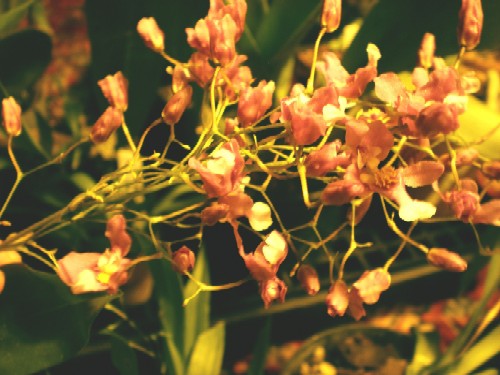
3. Oncidium Ornithorhynchum

Smells sort of like candy, or bubble gum. This plant blooms with tons of pink flower. Here is a picture of the one I have blooming right now.

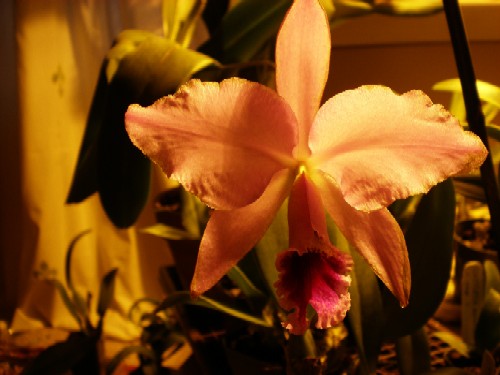
4. Cattleya Percivaliana

Smells like bread dough, with a lot of yeast. It is an odd smell, but does remind one of food. This orchid is often called the Christmas orchid, because it generally blooms in November or December. Here is a picture of the one I have that’s blooming right now.

Sunday, November 19, 2006

The Secret to Growing Gorgeous Orchids

Humidity, Humidity, Humidity.

This can be a very tricky one, but you need to raise the humidity. Humidity in a normal household is far too low for orchids to thrive. It is important to bring it up to at least 40 or 50 percent. In cold climates during the winter relative household humidity often averages close to 20 percent (Frowine). Household humidity can be even lower in desert areas. At humidity that low orchid leaves will begin to shrivel and flowers will brown and drop off. Something called Bud Blast will often occur in low humidity situations (especially on Phalaenopsis orchids). This is where the developing flower buds drop off before they have a chance to open.

Some orchids can adapt to lower humidity than others, so it is important to know how adaptable your orchids are. However, in general, no orchid is going to thrive at humidity below 35%-40%. Last winter my humidifier broke and the humidity around my plants was hovering near 35%. Most of my orchids survived this period, but they didn’t love it. I was also misting them several times a day. Misting is generally not recommended, because it only brings up the humidity temporarily and can cause orchid plants to rot.

Check back tomorrow for 10 Tips on How to Raise the Humidity in your Orchid Room

Saturday, November 18, 2006

About Me and This Blog, The Armchair Orchidist

I love orchids. I have been growing orchids now for a while and I just think they’re amazing plants. I first became interested in orchids when I was a kid. I tried growing a couple, but never had much success.

I used to think I couldn’t grow them in my home, but I have discovered that with a little work and patience it’s really not that hard. These are incredible plants. Orchidae is the most diverse and complex plant family on earth, with so many different species and varieties it’s astounding. People have also played a major role in orchid ecology, both as a destructive force and a constructive one through creating manifold new hybrids and growing orchids just about everywhere people live.

This blog is intended to share some of the expertise and passion I’ve gained in growing orchids over the past year. It is really intended as an informational site for beginning and intermediate orchid growers, who grow orchids in the home. As I have gained more knowledge about the basics of orchid growing I have found myself wishing that some of this information was more accessible. Most of all, I simply want to share my excitement with others who are just getting started with these amazing and complex plants.